
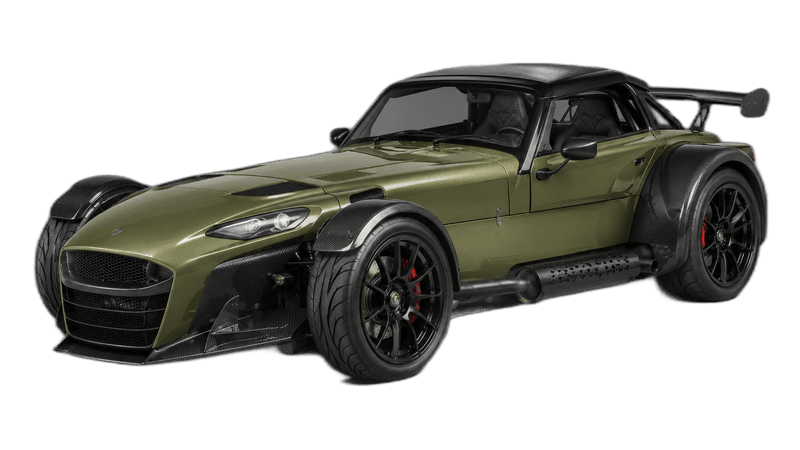
Donkervoort D8 GTO-JD70
£180,000
usedIndicative market price, updated periodically.
415bhp
Power
2.7s
0-100 km/h
280km/h
Top Speed
£180,000
Price Used
How hard it pulls.
Peak g-force the instant you bury the throttle, estimated from the car's 0–100 time and drivetrain.
Donkervoort D8 GTO-JD70Estimated peak launch g from the 0–100 time and drivetrain: an honest approximation, not a measured figure.
The Donkervoort D8 GTO-JD70 is a 2-seater roadster by Donkervoort, with 415 bhp, 560 Nm of torque, a 0-100 km/h time of 2.7 seconds and a top speed of 280 km/h. Indicative used value: approximately £180,000. Actual values vary with specification, condition and history.
Dream Car Garage Editorial · Last updated 3 November 2026
Overview
We have not driven this car. This review is based on published specifications and the sources listed below.
Scope of this guide
This guide is scoped to the Donkervoort D8 GTO-JD70, the two-seat, open-cockpit, rear-wheel drive special edition that Donkervoort Automobielen of Lelystad in the Netherlands announced in 2019 and began delivering in June 2020 to mark the 70th birthday of its founder, Joop Donkervoort. It is not a guide to the earlier D8 GTO, the D8 GTO-40, the D8 GTO Individual Series or the track-only D8 GTO-JD70 R, which the maker sells as separate cars, and it does not cover the Bare Naked Carbon Edition of the JD70 except where we say so. An advert that says only "Donkervoort D8 GTO" can describe any of them, so check the exact name and chassis.
We have not driven this model for this article. Everything here comes from three cited sources: the specification page for the car on Donkervoort's own website (donkervoort.com), PistonHeads' report on the car (first published 24 October 2019 and updated 16 June 2020), and the government recall checker. We also read Donkervoort's launch press release on the same site, Top Gear Netherlands (16 June 2020) and evo (28 July 2020), and we mark every point that rests on them. Where sources disagree we say so rather than pick a winner quietly. Prices are history, not valuations.
The figures at a glance
- Engine: 2.5L Turbo Inline-5, an Audi 2.5 litre TFSI turbocharged five-cylinder petrol engine, which Donkervoort's table describes as an in-line five. The table gives 2480 cc, a bore and stroke of 82.5 x 92.8 mm and a compression ratio of 10.0:1.
- Power: 415 bhp, which the specification table gives as 300 kW at 5850 to 7000 rpm. The launch press release gives the same 415 bhp but 310 kW, and 415 bhp does work out at about 310 kW (415 x 0.7457), so the 300 kW in the table looks like a rounding slip. PistonHeads prints 420 hp, which is the metric equivalent of about 421 PS and not a different tune.
- Torque: 560 Nm at 1750 to 6350 rpm on the specification table. The press release, Top Gear Netherlands and the Bare Naked Carbon Edition page give 520 Nm, and evo prints 383 lb ft, which is about 519 Nm. We use 560 Nm because it is the figure on the maker's current specification page, and we flag the older 520 Nm figure as a conflict.
- 0-100 km/h: 2.7 seconds, and 0-200 km/h in 7.7 seconds, both from Donkervoort. Top Gear Netherlands wrote "just under 2.7 seconds". Evo, in July 2020, said the figure was not yet announced and quoted 2.8 seconds for the existing range-topper. A figure of 2.5 seconds appears in some listings, and we found no maker source for it.
- Top speed: 280 km/h, claimed by Donkervoort. We found no independent two-way test.
- Drive: rear-wheel drive through a five-speed Tremec manual gearbox with short throw, rev matching and a limited-slip differential. Top Gear Netherlands says the power goes to the rear wheels. Donkervoort's table lists the gearbox and differential but has no line that names the drive layout.
- Weight: 680 kg unladen to DIN, a figure the maker's table gives with 610 bhp per tonne. PistonHeads says sub-700 kg and evo says 700 kg for the standard car, so weigh the specific car rather than trusting the brochure.
What kind of car this is
The D8 GTO-JD70 is a very small, very light, hand-built roadster. It is 3836 mm long, 1850 mm wide and 1081 mm high on a 2350 mm wheelbase, with a cloth roof, two doors and a 250 litre luggage space according to the maker. Donkervoort says more than 95 per cent of the bodywork is carbon fibre and Kevlar, some of it 3D-printed, over a hybrid carbon, aluminium and steel tubular chassis. The steering is a rack with no power assistance, as standard, and the dampers are Intrax three-way adjustable units. The tyres on the specification table are Nankang AR-1 road-legal track tyres in 235/45 R17 front and 245/40 R18 rear, a sport-oriented tyre that we would expect to feel very different from an ordinary road tyre in the wet or when cold. That is our expectation, not a tested claim, so ask the owner what is fitted and how it behaves.
The performance claims are unusual too. Donkervoort says the car was tested beyond 2G of lateral acceleration on those standard tyres and lists a maximum of 2.05 g, along with 1.02 g of longitudinal acceleration. These are the manufacturer's measurements, and we have not seen them independently repeated.
Years and how many were built
The car was announced in 2019 (PistonHeads' report is dated 24 October 2019), the press release gives first deliveries as 11 June 2020, and both the press release and Top Gear Netherlands say more than half of the cars were already sold or reserved by mid-June 2020. Donkervoort's wording is "only 70 JD70s will be built", one for each year of Joop Donkervoort's life. PistonHeads and evo repeat the 70-car figure. That is a limit announced at launch. We found no source that confirms how many were finished in the end, when the last one left Lelystad or whether the run was completed as announced, and we found no end date for production. That is why the catalogue gives 70 as the limit and leaves the end year open. A page under the heritage section of the maker's site suggests the car is no longer the current model, but we could not confirm that from the page text.
The price at launch was 163,636.36 euros before taxes, which PistonHeads converted to roughly 140,000 pounds before VAT and about 170,000 pounds with VAT. Evo gave about 150,000 pounds. Those are history, not a valuation, and a used car will be priced by the market, the options and the history.
What the 2.5 litre engine means for an owner
The engine is Audi Sport's 2.5 litre five-cylinder, the same engine that PistonHeads says is in the RS3, and Donkervoort says has won its class in the International Engine of the Year awards for ten years in a row. The maker's table lists a side-pipe exhaust with a particulate filter, but we found no source that says what Donkervoort changed on the engine itself. The maker's table gives 8 litres per 100 km combined, 191 g/km of CO2 on the WLTP cycle and a 48 litre fuel tank, so a track day will empty the tank quickly.
We found no published service schedule, running cost or parts price list for the JD70. The base engine is an Audi unit, but the chassis, bodywork and installation are Donkervoort's own, so we would assume, without a source to prove it, that many parts come from Lelystad or a Donkervoort dealer and not from an Audi parts counter. Anyone who quotes a service price is giving an estimate.
What to check before buying
- Confirm that it is a D8 GTO-JD70 and not another GTO variant, and that the chassis number matches the maker's records. Ask Donkervoort Automobielen to confirm the build date and the specification.
- Ask which power and torque figure the car was delivered with, and whether the engine map has been altered. Early documents say 520 Nm and the current page says 560 Nm.
- Ask for the service history from Donkervoort or an approved dealer, and for any record of engine, gearbox, differential or cooling work.
- Look closely at the carbon bodywork, front and rear aero, side pipe, wheels and tyres for damage from track use. A car that has lived on a circuit can look very different from one that has been shown at events.
- Find out how and where the car was registered, what type approval it has, and what that means for road tax, insurance and MOT or equivalent testing in your country.
- Check which optional items are fitted, such as the electric power steering or the six-piston rear calipers, because the maker lists them as options.
- Get an independent inspection from a specialist who knows a lightweight tubular-chassis car, because there is no large dealer network.
Recalls and the DVSA check
The government recall checker is built for mass-produced vehicles. It asks for a registration number or, without one, the make, model and year, and it says it will tell you about recalls the manufacturer has made for a serious safety problem. It also says that you will be told by the manufacturer of any recall for a reason other than safety. We did not run the checker, because we are not looking at a specific car.
For a hand-built, low-volume Dutch car, the checker can tell you only whether a safety recall has been recorded against the registration, or against the make, model and year you enter. It cannot tell you about service bulletins, voluntary updates or rectification work that Donkervoort carries out directly with owners, and a car that was imported or registered under a special approval may not return a result at all. We found no recall notice for the JD70 in any source, and absence from our sources is not a clean bill of health. Ask Donkervoort Automobielen whether any bulletin, update or recall applies to the chassis you are looking at, and ask for that answer in writing.
About the photograph
The picture at the top of this page shows a D8 GTO-JD70 on display at IAA 2021 in Frankfurt, photographed by Alexander Migl and used under a Creative Commons licence. We cropped and resized it to this shape, and it is a rear view. The car in the photograph is in dark red with a black roll hoop and its doors raised, and the specification of that particular car is not stated on the picture page, so we use it only to show the shape.
Verdict
The D8 GTO-JD70 is a 70-car limited edition with a 2.5 litre Audi five-cylinder making 415 bhp and 560 Nm on the maker's current table, a claimed 2.7 seconds to 100 km/h and 280 km/h, rear-wheel drive and a stated 680 kg. It is a rare, hand-built and demanding machine, so the paperwork, the chassis confirmation and the car's use history matter more than the headline numbers. If you are shopping for one, verify which specification you are looking at, insist on a full history and on written confirmation from the maker, and treat every published figure as a claim with the caveats above. We have not driven it, so use the sources and a proper inspection to decide.
Specifications
Engine
2.5L Turbo Inline-5
Displacement
2.5L
Power
415 bhp
Torque
560 Nm
0-100 km/h
2.7s
Top Speed
280 km/h
Drivetrain
RWD
Country
Netherlands
Body Style
2-seater roadster
Years
2020–present
Production
70
Price Used
£180,000
Specifications are manufacturer-published figures.
Frequently Asked Questions
What are the specifications of the Donkervoort D8 GTO-JD70?
The Donkervoort D8 GTO-JD70 is a 2-seater roadster by Donkervoort, with 415 bhp, 560 Nm of torque, a 0-100 km/h time of 2.7 seconds and a top speed of 280 km/h. Indicative used value: approximately £180,000. Actual values vary with specification, condition and history.
How much does a Donkervoort D8 GTO-JD70 cost?
Indicative used value: approximately £180,000. Actual values vary with specification, condition and history.
How many Donkervoort D8 GTO-JD70 were made?
Donkervoort produced 70 units of the Donkervoort D8 GTO-JD70.
What drivetrain does the Donkervoort D8 GTO-JD70 use?
The Donkervoort D8 GTO-JD70 is configured with rear-wheel drive.
What type of car is the Donkervoort D8 GTO-JD70?
The Donkervoort D8 GTO-JD70 is a track focused manufactured by Donkervoort in Netherlands. Production started in 2020.