
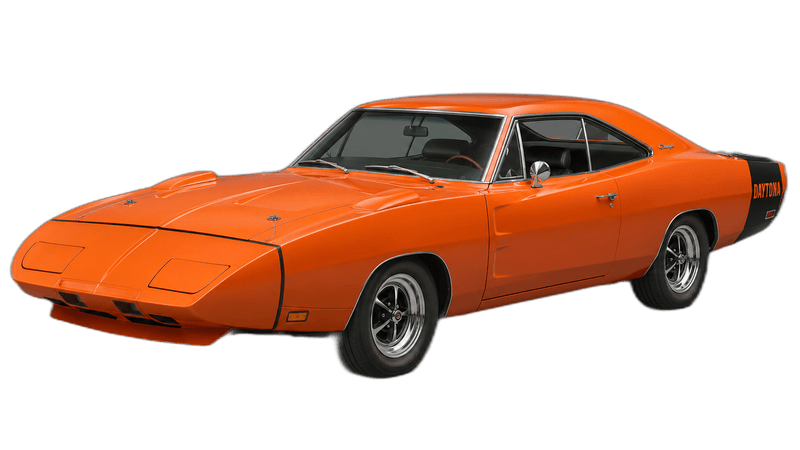
Dodge Charger Daytona
425bhp
Power
The Dodge Charger Daytona is a 2-door coupé by Dodge, with 425 bhp and 664 Nm of torque.
Dream Car Garage Editorial · Edited by José Teo Lorente Vallecillos · Last updated 3 November 2026
Overview
We have not driven this car. This review is based on published specifications and the sources listed below.
Scope of this guide
This guide is scoped to the Dodge Charger Daytona, the 1969 street version of the winged Charger that Dodge built so that its racing cousin could be homologated for NASCAR. It is a two-door coupe with a front-engine layout and rear-wheel drive, and the engine we treat as the headline is the 426 cubic inch Hemi V8. The 440 cubic inch Magnum V8 was the standard engine, and we cover it too, because far more cars had it. We do not cover the later Dodge models that reuse the Daytona name from 2006 onward, and we do not cover the Plymouth Superbird except where a source compares it with the Daytona.
We have not driven this model for this article. We are an editorial desk that reads sources, and everything below comes from pages we opened: Wikipedia's Dodge Charger Daytona and Chrysler Hemi engine articles, the automotivehistory.org page on the Daytona's debut, Old Cars Weekly, Supercars.net, Amazing Classic Cars, and two Mopar Insiders auction stories plus a Motorious auction report. This is a collector car that rarely comes to market. A guide like this cannot replace an inspection by a specialist who knows these cars, and this page is for research, not a buying recommendation.
The figures at a glance
- Engine: 7.0L naturally aspirated V8, the 426 Hemi. Two sources print 426 cu in (6,981 cc). The Hemi article also gives a bore of 4.25 in and a stroke of 3.75 in, which by our own arithmetic multiply out to about 425.5 cu in, or roughly 6,974 cc. Both numbers are the same engine described two ways, and we use the nominal 426 cu in and 6,981 cc. We say naturally aspirated because the sources describe two four-barrel carburettors and mention no supercharger or turbocharger; that wording is our reading rather than a phrase any source uses.
- Power: 425 bhp. Every source that gives the Hemi rating says 425 hp at 5,000 rpm. That is a gross SAE figure, explained below. We treat hp and bhp as the same number here and do no conversion.
- Torque: 664 Nm. The sources give 490 lb-ft at 4,000 rpm (Wikipedia's Hemi article) or 5,100 rpm (Amazing Classic Cars). Supercars.net prints 664.35 Nm. We converted 490 lb-ft at 1.3558 and arrived at the same 664 Nm.
- 440 Magnum: 375 hp at 4,600 rpm and 480 lb-ft at 3,200 rpm, per Amazing Classic Cars. Wikipedia's Daytona page lists 390 hp and 425 hp for the car without matching them to engines, so we do not know from that page which engine carried 390 hp.
- 0-100 km/h: no figure shown. None of the pages we read gives a measured acceleration time for the Daytona road car, so the catalogue should not show one.
- Top speed: no figure shown. Supercars.net says plainly that a top speed is not stated for the road car. The 200 mph claim belongs to a NASCAR race car, not a showroom one.
- Drive: rear-wheel drive. Wikipedia lists a front-engine, rear-wheel-drive layout, a 4-speed manual or a 3-speed TorqueFlite 727 automatic.
- Weight: 3,719 lb (1,687 kg) per Amazing Classic Cars, a spec-sheet page and not a maker document.
- Size: 117 in (2,972 mm) wheelbase, 226.5 in (5,753 mm) long, 79.6 in (1,946 mm) wide and 53.0 in (1,346 mm) high, per Amazing Classic Cars. Wikipedia agrees on wheelbase and length.
- Production: 503 cars, with 70 of them Hemi-powered.
What gross horsepower means
American manufacturers rated engines in SAE gross horsepower until 1972. Wikipedia's Chrysler Hemi article describes gross as roughly the engine's maximum output, and says ratings changed to SAE net from 1972, which accounts for accessories and exhaust. It also notes that Chrysler's 1971 Hemi literature listed 350 hp net next to the 425 hp gross figure. So 425 bhp is a 1960s bench number and not directly comparable with a modern car's quoted output measured under today's rules.
The article from Amazing Classic Cars says the Hemi made more like 500 hp, and Mopar Insiders says many believed the factory rating was underrated. The Hemi article carries a dyno claim of 433.5 hp and 472 lb-ft for stock street Hemis, but that claim is tagged citation needed, so we do not rely on it. We keep the factory 425 bhp because it is the only rating all our sources share, and we treat anything higher as folklore until a measured, sourced test is shown.
Why the Daytona exists
The story across our sources is consistent. Dodge's Charger had a blunt nose and a coke-bottle body that created too much drag and lift at superspeedway speeds. The earlier Charger 500, a limited-edition 1969 car, was a racing disappointment, and Old Cars Weekly says as few as 392 of them may have been built. Wikipedia links the Daytona to that failure and to Richard Petty leaving Plymouth for Ford. Old Cars Weekly dates the Super Charger project approval to March 12, 1969, and says Creative Industries of Detroit, which had completed the Charger 500 conversion, also did the Daytona conversion.
The result was a sheet-metal nose cone that replaced the Charger's flat face with a wedge, plus a rear stabilizer wing 23 inches tall (584 mm) according to Wikipedia and Old Cars Weekly. The automotivehistory.org page adds window caps and other aerodynamic changes. Wikipedia credits designers Bob Marcell, Gary Romberg and John Pointer. NASCAR required 500 cars for homologation, and Dodge put 503 on dealer lots.
Racing history and the 200 mph claim
The Daytona won the inaugural Talladega 500 on September 14, 1969, driven by Richard Brickhouse, though the automotivehistory.org page notes that Richard Petty, David Pearson, Cale Yarborough and many others boycotted over tyre safety concerns. Wikipedia and the automotivehistory.org page agree on two wins in 1969 and four in 1970, six in all. Amazing Classic Cars says 22 wins across 1969 and 1970. The sources do not agree, and we use six because two sources give the same breakdown.
The 200 mph claim is where road-car and race-car numbers get confused. Mopar Insiders reports that Buddy Baker set an official lap of 200.447 mph on March 24, 1970, at Alabama International Motor Speedway, now Talladega, in the number 88 Chrysler Engineering car nicknamed the Blue Car. That car had a 426 Hemi EX-144 race engine with a Holley Dominator carburettor, rated at 575 hp, and it began life as a 1969 Charger 500 press car converted by Nichels Engineering. The same article says Bobby Allison, Dan Gurney, Bobby Isaac and James Hylton were among the drivers who tested it. None of that describes a showroom Daytona, so we do not attach 200 mph, or any conversion of it, to the road car.
By the end of 1970 NASCAR had effectively banned the aero cars. Wikipedia says the rule targeted engines larger than 305 cubic inches, while the automotivehistory.org page gives the limit as 300, so the sources differ by a few cubic inches on the number.
Variants and what changed over the run
There were really two road cars, set by the engine. The 440 Magnum was standard on the Daytona, which was built on Charger R/T specification, per several sources, and only 70 of the 503 cars had the 426 Hemi. By subtraction that leaves 433 cars without a Hemi, but that is our arithmetic and no source prints it.
Both the 4-speed manual and the 3-speed TorqueFlite automatic were offered. Mopar Insiders says one auctioned Hemi car was one of 22 Hemi Daytonas with an A833 4-speed manual, which suggests manual Hemi cars are even scarcer, though we did not find that number in a second source.
On the build itself, sources disagree on small points. Wikipedia names Lynch Road Assembly in Detroit, while the Mopar Insiders auction story and Old Cars Weekly name the Hamtramck plant for the cars they describe. We did not resolve this. On price, Wikipedia's production table gives a 1969 base price of 5,903 US dollars, and Supercars.net prints 3,860 US dollars. We think the Wikipedia figure is likelier for a Daytona, but we cannot verify either from a maker price list, so treat both with caution.
The 503 versus 505 question
The 503 production figure comes from Wikipedia, the automotivehistory.org page, Old Cars Weekly and the 2022 Mopar Insiders auction story, which adds that the number is sometimes disputed. Supercars.net says 505, and we found no explanation for the two-car gap. Another search result suggested the real total might be higher, but we did not open that page and do not use it. We show 503 because four pages agree on it and it sits just above the NASCAR 500-car requirement. Wikipedia's infobox also lists the first generation as 1969-1970, while the other pages describe 1969 cars, so we keep a single 1969 model year.
What the rarity means for a buyer
We found no buyer's guide with a mechanical fault list, a service schedule, running costs or recall data for the Daytona, so we give none. What the auction stories do show is how much weight a car's paperwork carries. The Mecum Indy car was described as well documented, with a build sheet and fender tag decoded. The Mecum Kissimmee car was sold with documented mileage of 6,490 miles and described as the lowest-mileage original-engine 4-speed Hemi Daytona documented.
- Check the engine against the build sheet, because Hemi and 440 cars look identical from outside and are priced very differently.
- Ask for the decoded fender tag and build sheet that sources describe on the auctioned cars.
- Confirm that the nose cone and wing are original to the car and not later additions. The history page and Old Cars Weekly describe both as defining parts.
- Be cautious with any claim that a car was a race car. Mopar Insiders says the Blue Car's history is verified by a letter of authenticity from George M. Wallace, which shows the kind of paperwork race-car claims rest on.
Market and value notes
Mopar Insiders reported a 1969 Hemi Daytona in dark green with a 4-speed that sold for 1,320,000 US dollars at Mecum Indy on May 20, 2022. Motorious reported on January 19, 2023 that a copper Hemi 4-speed car sold at Mecum Kissimmee for 1,300,000 US dollars hammer and 1,430,000 including fees, and called it a record for a 1969 Daytona by 110,000 dollars. Two search results suggested higher later prices, but we did not open those pages, so we quote nothing from them. These are two Hemi sales and not a price guide, and a 440 car would sit differently. Hagerty's valuation pages blocked us, so we have no valuation range.
What we could not find
We found no measured 0-100 km/h time, no road-car top speed and no maker performance claim for the Daytona road car, which is why those two catalogue figures show no figure shown. We found no running costs, no recall information and no buyer's checklist from a specialist, and no official Dodge production breakdown. We did not search a recall database or a registry.
About the photograph
This page uses the catalogue photograph for the car. Its credit is listed on the credits page.
Verdict
The 1969 Charger Daytona is a front-engine, rear-wheel-drive coupe whose 7.0L naturally aspirated V8 in Hemi form carried a gross rating of 425 bhp and 664 Nm. Only 70 of the 503 cars had it, and we cannot honestly give a 0-100 km/h time or a road-car top speed from anything we read. The famous 200 mph belongs to a 575 hp race car, not a showroom one. What you are researching is a homologation special, valued for documentation, engine and originality. We have not driven it, so rely on the paperwork and an independent specialist inspection rather than on this page.
Sources
- Wikipedia: Dodge Charger Daytona
- Wikipedia: Chrysler Hemi engine
- Automotive History (automotivehistory.org): Dodge Charger Daytona debuts
- Old Cars Weekly: Car of the Week, 1969 Dodge Daytona number one
- Supercars.net: 1969 Dodge Charger Daytona
- Amazing Classic Cars: 1969 Dodge Daytona
- Mopar Insiders: The first 200 mph Dodge Charger Daytona heads to auction
- Mopar Insiders: Hemi-powered 1969 Dodge Charger Daytona at Mecum Indy 2022
- Motorious: 1969 Hemi Daytona sells at Mecum Kissimmee
Specifications
Engine
7.0L naturally aspirated V8
Displacement
7.0L
Power
425 bhp
Torque
664 Nm
Drivetrain
RWD
Country
United States
Body Style
2-door coupé
Years
1969
Production
503
Specifications are manufacturer-published figures.
More from Dodge
Frequently Asked Questions
What are the specifications of the Dodge Charger Daytona?
The Dodge Charger Daytona is a 2-door coupé by Dodge, with 425 bhp and 664 Nm of torque.
How many Dodge Charger Daytona were made?
Dodge produced 503 units of the Dodge Charger Daytona.
What drivetrain does the Dodge Charger Daytona use?
The Dodge Charger Daytona is configured with rear-wheel drive.
What type of car is the Dodge Charger Daytona?
The Dodge Charger Daytona is a sports cars manufactured by Dodge in United States. Production ran from 1969 to 1969.