
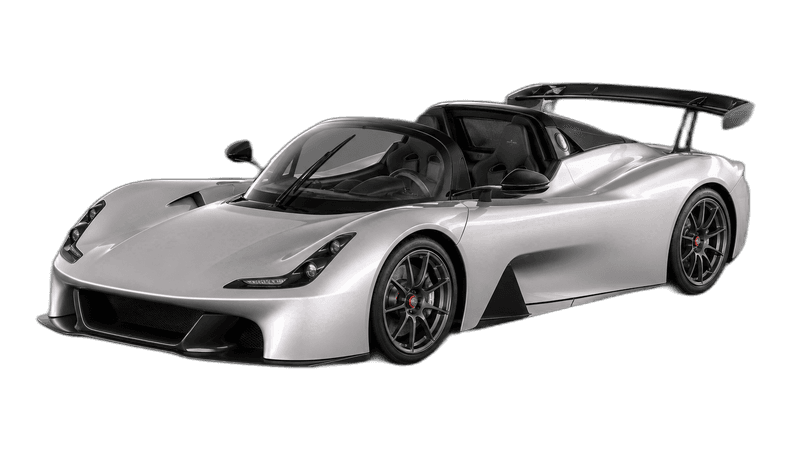
Dallara Stradale
£165,000
usedIndicative market price, updated periodically.
395bhp
Power
3.25s
0-100 km/h
280km/h
Top Speed
£165,000
Price Used
How hard it pulls.
Peak g-force the instant you bury the throttle, estimated from the car's 0–100 time and drivetrain.
Dallara StradaleEstimated peak launch g from the 0–100 time and drivetrain: an honest approximation, not a measured figure.
The Dallara Stradale is a 2-seat barchetta by Dallara, with 395 bhp, 500 Nm of torque, a 0-100 km/h time of 3.25 seconds and a top speed of 280 km/h. Indicative used value: approximately £165,000. Actual values vary with specification, condition and history.
Dream Car Garage Editorial · Last updated 3 November 2026
Overview
We have not driven this car. This review is based on published specifications and the sources listed below.
Scope of this guide
This guide is scoped to the Dallara Stradale, the road-legal carbon-tub barchetta from Dallara Automobili of Varano de' Melegari, Italy, in its standard road specification with the 2.3L Turbo Inline-4 petrol engine, rear-wheel drive and a mid-mounted engine behind the two seats. It is not a guide to the track-only Dallara EXP, which has 500 hp and 700 Nm and its own price and paperwork, to the optional track-oriented engine map and exhaust the maker offers, or to the Stradale as a kit of loose parts. Where those differ we say so, because an advert that says only "Stradale" can describe a doorless barchetta, a roadster with a screen, a targa or a gull-wing coupe, and they do not feel or cost the same.
We have not driven this model for this article. Everything here comes from three cited sources: the maker's own Stradale site at stradale.dallara.it, PistonHeads' report on the car's launch on 16 November 2017, and the government vehicle recall checker. We also read the maker's downloadable brochure (a PDF on the same site, which we converted to text and read in full), plus summaries of Auto Express, evo, Goodwood, Autodata and Wikipedia, and we flag every point that rests on them. Where sources disagree we say so rather than pick a winner quietly. Prices are history, not valuations.
The figures at a glance
- Engine: 2.3L Turbo Inline-4 petrol, a four-cylinder turbocharged engine that PistonHeads and Wikipedia identify as a Ford EcoBoost unit, and that Wikipedia says Bosch reworked. The maker's own pages say only "2300 cc, 4 cylinders, turbocharged". We store 2261 cc, which is the figure Autodata prints for the car and the capacity of the Ford 2.3 EcoBoost, while 2300 cc is the maker's rounded figure.
- Power: 395 bhp. Dallara prints 400 hp at 6200 rpm, and its Italian brochure text says "400 CV", which is metric horsepower. 400 PS is about 395 bhp (400 x 0.98632 is about 394.5), and Wikipedia gives 400 PS and 395 hp for the same car, Auto Express says 395 bhp and evo says 394 bhp. That is our own conversion and we have not seen the maker state a bhp figure, so the "400 hp" on the maker's page is a rounded, metric number.
- Torque: 500 Nm. The maker's specification table gives 500 Nm at 3000 to 5000 rpm, while the paragraph above it says a constant 500 Nm between 2000 and 5000 rpm, so the width of the torque plateau is unclear.
- 0-100 km/h: 3.25 seconds, from the maker's specification table. Goodwood printed 3.45 seconds at the 2017 launch, and Wikipedia gives 3.2 seconds for 0 to 60 mph, which is a different test. The maker also lists 80 to 120 km/h in fifth gear in 3.49 seconds and 100 to 200 km/h in fifth in 8.5 seconds.
- Top speed: 280 km/h with the maker's figure. Goodwood printed "more than 280 km/h" and 265 km/h with the optional rear wing, which we did not see repeated by the maker.
- Drive: rear-wheel drive, with the engine mounted transversely behind the cabin, and either a six-speed manual or a paddle-shift automated manual gearbox. Wikipedia describes the layout as a transverse rear mid-engine.
- Weight: 855 kg dry, which is the maker's figure, with the carbon monocoque and full carbon bodywork. Auto Express printed 885 kg for standard trim at the launch, which we cannot reconcile with the maker's 855 kg, and every other source we read gives 855 kg. Dry means without fluids, so a car ready to drive weighs more.
- Size: 4180 mm long, 1870 mm wide, 1041 mm high, with a 2475 mm wheelbase, on the maker's table.
What the car actually is
PistonHeads reported the launch on 16 November 2017, the day Gian Paolo Dallara turned 81, and called it a dramatic and decidedly upmarket rival to the Lotus 3-Eleven. Dallara is best known for building racing chassis, and PistonHeads notes that it consulted on the carbon architecture of the Bugatti Veyron and built the KTM X-Bow. The Stradale is its first road car under its own name. The maker describes it as light, mechanically pure and analogue, with a carbon-fibre monocoque, front and rear double wishbones and three-way adjustable dampers with electronic ride-height setting. The steering is mechanical, and PistonHeads says it has no power assistance, a geared self-locking differential is fitted, and Bosch ABS and stability control are on board.
The standard car is a barchetta with no doors, screen or roof. The maker says adding a polycarbonate windscreen makes it a roadster, a T-frame makes it a targa, and gull-wing doors make it a coupe. PistonHeads priced those parts in 2017 as a removable carbon-framed windscreen at 16,600 euros, a targa roof at 7,700 euros and see-through canopy doors at 7,300 euros. The car was meant to be configurable, so two examples can be quite different machines.
Aerodynamics and the sums on downforce
The maker offers Track and Standard aerodynamic configurations. Its brochure says up to 820 kg of downforce with the carbon rear wing in Track form, with about half in Standard form, while the current website says up to 855 kg with a new front-louvre setup, a one-to-one ratio with the car's dry weight. Goodwood's 2017 launch story gave 265 km/h as the top speed with the wing fitted. These are different dates and configurations, and the maker's top speed of 280 km/h is not tied to a configuration. If a seller quotes a downforce or top speed figure, ask which wing, which louvres and which ride height were fitted.
How many were built, and when
PistonHeads, evo and Goodwood all reported a plan of about 600 cars over five years, sold direct from the factory, with PistonHeads saying the first year's production had sold out and that the first examples were due to be delivered in the week of the launch. That is why we show the start year as 2017. Our earlier catalogue entry showed 2018, which may reflect the first full model year. We found no source that counts how many cars Dallara has actually built, and Wikipedia gives only the plan, so our catalogue gives no production number. The car is still on sale in the maker's current literature, which lists it as meeting Euro 6E emissions rules, so we show no end year.
What it cost
PistonHeads gave the 2017 price as 155,000 euros before taxes, over 200,000 pounds fully loaded once Italian VAT of 22 percent was included. Wikipedia cites Car and Driver for a 2018 price of 191,000 euros before taxes, which looks like a car with options, and we could not check that. We did not find a current list price. The maker also sells upgrade kits, including EXP-derived aerodynamic parts, stiffer suspension springs, centre-lock wheels and an air-jack system, so a used car's specification may no longer match the one that left the factory.
What to check before buying
- Confirm the configuration: barchetta, roadster, targa or coupe, and which aero parts are fitted. Ask for the build sheet from the dealer or from Dallara.
- Ask whether the track engine map and exhaust, or any EXP upgrade kit, have been fitted, and whether non-homologated parts were removed before road use. The maker says track-only parts can be taken off to restore the road set-up, so ask for the evidence.
- Check the gearbox type, manual or paddle-shift, and ask for a service history from a Dallara dealer. The maker names a dealer network and a Stradale service organisation, but we did not look up specific dealers in your country.
- Inspect the carbon tub, bodywork and underfloor for impact and track damage. A damaged monocoque is a structural matter and needs a specialist.
- Ask how the car is registered where you live, because a doorless barchetta can raise insurance and roadworthiness questions that a normal coupe does not.
- Check tyre age and brake wear, because we found no published tyre or brake specification beyond what the maker lists, and a car used on track may have had both replaced often.
- Get an independent inspection by someone who knows carbon-tub cars, since there is no mainstream workshop network.
Running costs and fuel
We found no independent running-cost data, no published service schedule and no parts price list. The maker's brochure gives fuel consumption of 12.8 litres per 100 km in town, 7.0 extra-urban and 7.6 combined, and 216 g/km of carbon dioxide on the WLTP test. Those numbers do not line up with each other, because 216 g/km points to about 9 litres per 100 km, so do not budget from the 7.6 figure. Anyone who gives you an annual cost for a Stradale is giving an estimate, not a published number.
Recalls and the DVSA check
We did not run the government checker, because it needs a registration number or the manufacturer, model and year, and we are not looking at a specific car. The page says that for a car with a registration it shows unfixed safety recalls and MOT history, and that without one you enter the manufacturer, model and year. It also says the manufacturer writes to owners about non-safety recalls. We found no recall notice for the Stradale in any source, and a Dallara may not be on the checker at all, since the Stradale is a very low-volume car and we do not know how many are registered in the UK. So the checker is worth a minute for a UK car, but an empty result tells you only that nothing was found, not that nothing exists. Ask Dallara or its dealer whether any service bulletin or campaign applies to the chassis number.
About the photograph
The picture at the top of this page shows a 2019 Stradale in pale blue, photographed at the Salon Prive concours at Blenheim Palace in September 2019, with the optional windscreen and a rear wing fitted. That makes it a roadster with a wing, not the doorless barchetta that is the standard car, and we cannot say which engine map or kit it has. We blurred the registration plate on the front bumper, and the picture is cropped and resized from the original.
Verdict
The Stradale in this guide is a 2.3L Turbo Inline-4 with 395 bhp (the maker says 400 hp, which is metric) and 500 Nm, rear-wheel drive and mid-engine, in a car the maker says weighs 855 kg dry and does 0 to 100 km/h in 3.25 seconds with a top speed of 280 km/h. It is a lightly equipped, highly configurable carbon car made in small numbers, so the exact configuration, history and paperwork matter more than any single headline figure. If you are shopping for one, ask for the build sheet and a Dallara-approved service record, get a specialist to check the tub, and treat every published figure as a claim with the caveats above. We have not driven it, so use the sources and a proper inspection to decide.
Specifications
Engine
2.3L Turbo Inline-4
Displacement
2.3L
Power
395 bhp
Torque
500 Nm
0-100 km/h
3.25s
Top Speed
280 km/h
Drivetrain
RWD
Country
Italy
Body Style
2-seat barchetta
Years
2017–present
Price Used
£165,000
Specifications are manufacturer-published figures.
Frequently Asked Questions
What are the specifications of the Dallara Stradale?
The Dallara Stradale is a 2-seat barchetta by Dallara, with 395 bhp, 500 Nm of torque, a 0-100 km/h time of 3.25 seconds and a top speed of 280 km/h. Indicative used value: approximately £165,000. Actual values vary with specification, condition and history.
How much does a Dallara Stradale cost?
Indicative used value: approximately £165,000. Actual values vary with specification, condition and history.
What drivetrain does the Dallara Stradale use?
The Dallara Stradale is configured with rear-wheel drive.
What type of car is the Dallara Stradale?
The Dallara Stradale is a track focused manufactured by Dallara in Italy. Production started in 2017.