 Dream Car Garage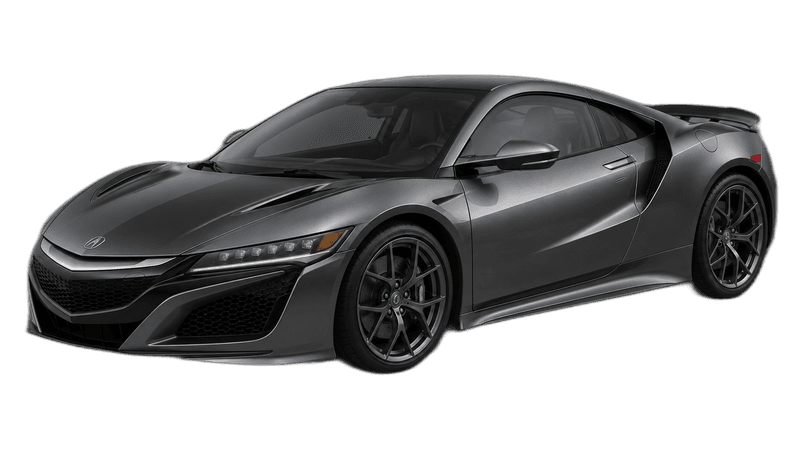
Acura NSX (2017)
£95,000
used573bhp
Power
3s
0-100 km/h
307km/h
Top Speed
£95,000
Price Used
How hard it pulls.
Peak g-force the instant you bury the throttle, estimated from the car's 0–100 time and drivetrain.
Acura NSX (2017)Estimated peak launch g from the 0–100 time and drivetrain: an honest approximation, not a measured figure.
The Acura NSX (2017) is a 2 seater fixed-head coupé by Acura, producing 573 bhp, and 645 Nm of torque, with a 0-100 km/h time of 3 seconds, and a top speed of 307 km/h, Valued at approximately £95,000.
Overview
The Acura NSX takes an unusual route through the 600-car catalogue: a turbocharged V6 paired with all-wheel drive in a two seater fixed-head coupé. Only 21 cars in the catalogue combine a V6 with AWD, and just 9 match the specific pairing of turbocharging, V6 layout and AWD. That decision shapes where the NSX sits, delivering a different balance from cars that pursue their performance through other configurations.
Its 3.5 litre V6 produces 573 bhp and 645 Nm, placing it 239th for power among 600 cars, inside the top 40% of the catalogue. The sharper measure of its character comes from acceleration, where its 0 to 100 km/h time of 3 seconds makes it faster than 488 of the 600 cars listed. The 307 km/h top speed ranks 237th, showing a car positioned firmly in supercar territory through a combination of traction and pace rather than a single headline figure.
That drivetrain choice also creates a clear identity within the catalogue. A V6 is not a common layout here, appearing in 51 of 600 cars, and the NSX sits within an even narrower group of 48 Japanese cars. Acura itself contributes two cars to the catalogue, making this NSX part of a small representation from its manufacturer within the collection. Its used price of £95,000 places it 295th by cost, meaning it is more expensive than 305 cars in the catalogue while carrying a cost of £166 per bhp.
The NSX asks a collector to consider what performance looks like when the specification avoids the obvious route. The turbocharged V6 and AWD system define the car’s place among 600 choices, combining measurable speed with a configuration shared by very few others in the database. It is a 2017 example of the Acura NSX range, which spans 2016 to 2022, and it brings a Japanese supercar option into a garage where variety is measured by engineering decisions as much as numbers.
The Acura NSX belongs in the garage.
Specifications
Engine
3.5 litre3492 cc(213.095 cu in) V 6 in 75° vee turbocharged petrol
Displacement
3.5L
Power
573 bhp
Torque
645 Nm
0-100 km/h
3s
Top Speed
307 km/h
Drivetrain
AWD
Country
Japan
Body Style
2 seater fixed-head coupé
Years
2016–2022
Price Used
£95,000
More from Acura
Frequently Asked Questions
What are the specifications of the Acura NSX (2017)?
The Acura NSX (2017) is a 2 seater fixed-head coupé by Acura, producing 573 bhp, and 645 Nm of torque, with a 0-100 km/h time of 3 seconds, and a top speed of 307 km/h, Valued at approximately £95,000.
How much does a Acura NSX (2017) cost?
The Acura NSX (2017) has a used market value of approximately £95,000.
How fast is the Acura NSX (2017)?
The Acura NSX (2017) produces 573 bhp, accelerates from 0-100 km/h in 3 seconds, and reaches a top speed of 307 km/h.
What is the Acura NSX (2017) horsepower?
The Acura NSX (2017) produces 573 bhp and 645 Nm of torque. The engine is a 3.5 litre3492 cc(213.095 cu in) V 6 in 75° vee turbocharged petrol unit with 3492L displacement.
What is the Acura NSX (2017) 0-60 time?
The Acura NSX (2017) accelerates from 0-100 km/h (0-62 mph) in 3 seconds, powered by 573 bhp with AWD drivetrain.
What is the Acura NSX (2017) top speed?
The Acura NSX (2017) has a top speed of 307 km/h (191 mph).
What is the Acura NSX (2017) price?
The Acura NSX (2017) is valued at approximately €110,200 (£95,000).
Is the Acura NSX (2017) AWD or RWD?
The Acura NSX (2017) uses a AWD drivetrain configuration in a 2 seater fixed-head coupé body style.
What type of car is the Acura NSX (2017)?
The Acura NSX (2017) is a supercars manufactured by Acura in Japan. Production ran from 2016 to 2022.